

Offset Printing vs Digital Printing: A Comprehensive Guide
Get Latest Quote
overview
Offset Printing vs Digital Printing: Cost, Quality and Which to Choose
Offset printing vs digital printing is the first question to settle when you plan brochures, catalogues, packaging, books or business stationery. The wrong choice can raise your cost, delay your delivery or leave your brand colors looking flat. The right choice gives you the best quality at the lowest price for your quantity and deadline.
At Shree Vishnu Press, our press in Okhla Phase-1, New Delhi, offers both offset printing and digital printing, so we have no reason to push one method over the other. This guide explains the difference between offset and digital printing in plain language, compares cost and quality, and helps you pick the right method for your job.
In-House Shree Vishnu Press Printing Facility
Our Printing Process
A simple 4-step process from your first enquiry to final delivery.
-
1Step 1
Share Requirement
Tell us your product, size, quantity and paper. We send a clear quote and delivery time.
-
2Step 2
Design & Proof
We check your design and share a proof. Printing starts only after your approval.
-
3Step 3
Printing & Finishing
Your job is printed with colour checks, then cut, laminated, folded or bound as needed.
-
4Step 4
Quality Check & Delivery
Final inspection, safe packing and on-time delivery to your doorstep.
Offset Printing vs Digital Printing: The Short Answer
Choose digital printing for short runs, quick turnaround and personalized prints. Choose offset printing for large quantities, exact brand colors and special papers. As a general rule, jobs below about 500 copies suit digital printing, and jobs above about 1,000 copies are usually cheaper on offset. Between those two numbers, the paper, size, page count and finishing decide which method wins. The sections below explain why, so you can order with confidence and avoid costly reprints later.
What Is Offset Printing?
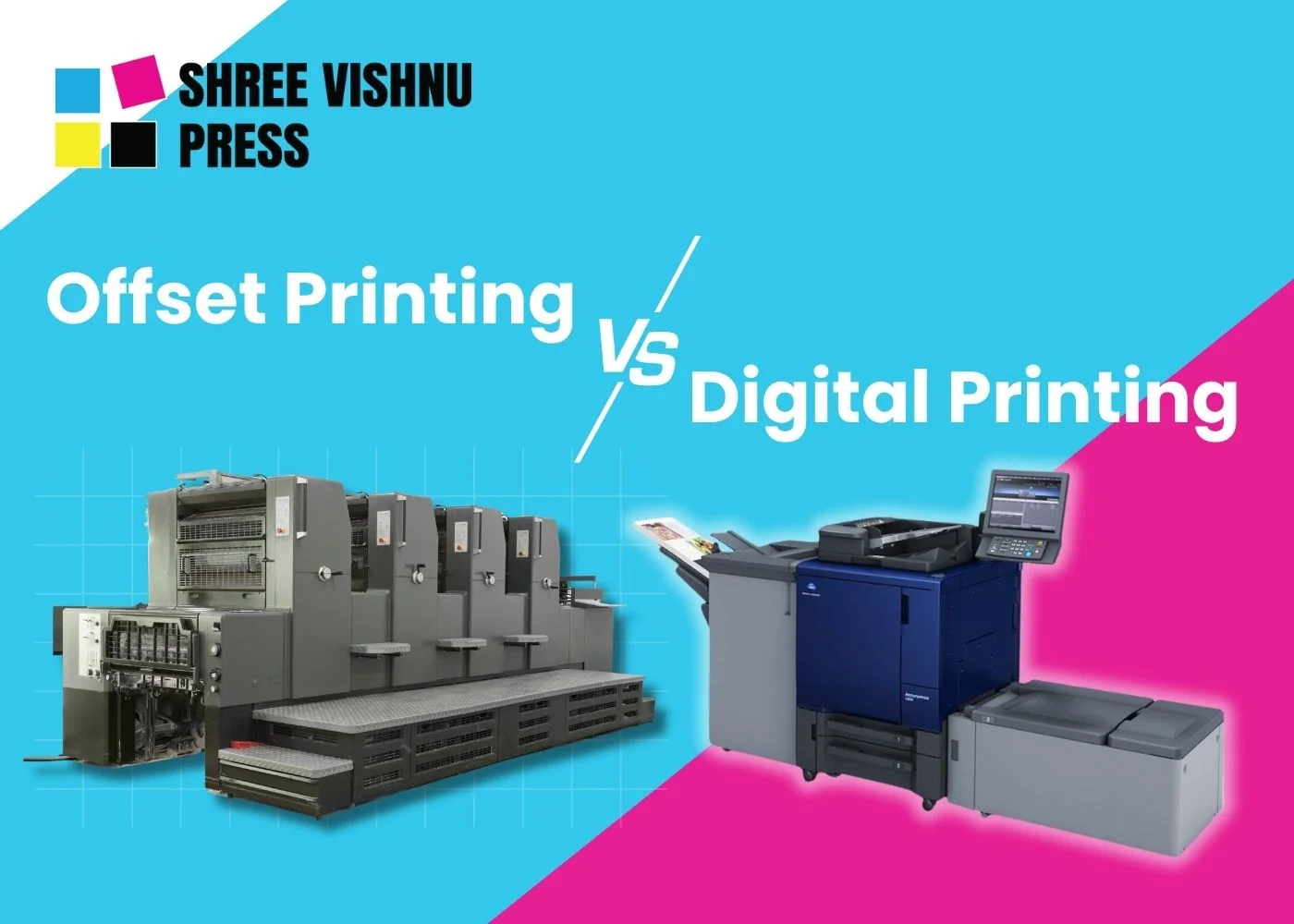
Offset printing, also called offset lithography, is a plate-based method. Your artwork is separated into four process colors (cyan, magenta, yellow and black), and sometimes extra Pantone spot colors. Each color is transferred to an aluminium plate. The plate passes the inked image to a rubber blanket, and the blanket presses it onto the paper. Because the image is offset from plate to blanket to paper, the print comes out sharp, smooth and even.
Preparing plates, balancing ink and running test sheets takes time and uses some paper. This is why offset has a higher starting cost. Once the press is running, it prints thousands of sheets an hour, and the cost of each extra copy falls sharply. Offset is the usual choice for:
- Books, magazines, catalogues and annual reports
- Brochures, leaflets and flyers in large quantities
- Packaging, cartons and folding boxes
- Letterheads, envelopes, files and corporate stationery
What Is Digital Printing?
Digital printing sends your file straight from the computer to the press, with no plates. Laser presses fuse toner onto the paper, while inkjet presses spray liquid ink. With no setup, the first copy costs almost the same as the thousandth, so you can order 50 copies or 5,000 without paying for tooling you do not need.
Digital printing also supports variable data printing, where every copy carries a different name, number, QR code or address. That makes it ideal for personalized invitations, certificates, direct mail and ID cards. Modern digital presses deliver bright, detailed color, and the print is dry the moment it leaves the press, which speeds up cutting, folding and binding.
Difference Between Offset and Digital Printing
The difference between offset and digital printing comes down to how the image reaches the paper, and that single point changes cost, speed and flexibility. This table shows the main differences side by side.
| Feature | Offset Printing | Digital Printing |
|---|---|---|
|
Setup Costs |
High, requires plate preparation and setup |
Low, no plates or setup required |
|
Turnaround Time |
Longer due to setup time and printing process |
Fast, immediate from digital file to print |
|
Print Quality |
High quality, consistent for large runs |
Good quality, but may lack consistency in large runs |
|
Best for |
Large print runs (e.g., magazines, books, brochures) |
Small to medium print runs (e.g., business cards, flyers) |
|
Cost-Effectiveness |
Economical for large volumes |
Economical for short runs, with higher unit costs for large runs |
|
Personalization |
Not suited for personalizing each print piece |
Ideal for personalized prints (variable data printing) |
|
Material Flexibility |
Handles various paper stocks and finishes |
Limited to standard paper types |
Offset Printing vs Digital Printing Cost
Offset printing vs digital printing cost is not a simple question of which is cheaper. It depends on quantity. Offset has a high fixed cost for plates and setup, but a low cost for every additional copy. Digital has almost no fixed cost, but each copy costs about the same whether you print ten or ten thousand.
Think of a brochure order. At 200 copies, the offset setup cost is divided across very few pieces, so each brochure is expensive and digital wins. At 5,000 copies, the same setup cost is spread so thin that it barely affects the price, and offset wins clearly. Somewhere between 500 and 1,000 copies the two methods cross over. Where exactly they cross depends on:
- Size and number of pages
- Paper type and GSM
- Number of colors and printed sides
- Finishing such as lamination, binding, creasing or die-cutting
- Your deadline
A practical tip: ask your printer to quote two quantities, for example 500 and 1,000 copies. On offset, the extra 500 copies often add only a small amount to the total, so the cost per piece drops noticeably. If you will use the material within a few months, the larger order can save money. If your content may change soon, a smaller digital run avoids waste. Also remember hidden costs. Digital printing wastes very little paper, which helps on short runs, while a poorly planned offset job can waste sheets during setup. Good file preparation avoids both problems.
Offset Printing vs Digital Printing Quality
Offset printing vs digital printing quality is where many buyers worry, so here is an honest comparison. Offset gives very smooth solid colors, crisp fine text and consistent results across a huge run. It also supports Pantone inks, which matters when your logo color must match exactly on every piece, month after month.
Digital printing has improved a great deal. On modern presses, photographs, brochures and business cards look excellent, and most people cannot tell the difference at normal viewing distance. Digital is also very consistent within a single run. The gaps appear in specific cases: matching a Pantone color exactly, printing on heavily textured or specialty stock, and reprinting the same job months later on a different machine.
In short, both methods can produce high-quality print. Offset has the edge for brand-critical color and premium papers, while digital is more than good enough for most short-run business material.
Benefits of Offset Printing and Digital Printing
The benefits of offset printing and digital printing are different rather than competing, because each solves a different problem.
Benefits of Offset Printing
- Lowest cost per copy on large runs
- Precise color control, including Pantone spot colors
- Works with the widest range of papers, from uncoated to textured
- Consistent results from the first sheet to the last
- Supports special effects such as spot UV, varnish and metallic finishes
Benefits of Digital Printing
- No setup cost, so short runs stay affordable
- Fast turnaround for urgent jobs
- Variable data printing for personalized material
- Print on demand, so you avoid storing thousands of unused copies
- Easy to test a design or change content between small batches
Best Printing Method for Bulk Orders
For most large jobs, offset is the best printing method for bulk orders. When you need thousands of catalogues, notebooks, cartons, brochures or forms, offset delivers the lowest cost per piece and identical quality across the entire quantity. Once the plates are made, the press keeps running at high speed, which also helps large orders finish on schedule.
Offset also gives you more control over paper and finishing in bulk. You can choose the exact stock, add coatings or metallic effects, and keep color the same if you reprint later. Bulk orders do need planning, though. Confirm the artwork early, approve the proof carefully, and share your deadline when you request the quote, because plate making, printing, drying and finishing all take time.
There is one exception. If a bulk order needs personalization, such as a different name or number on every piece, digital printing handles that better. In that case you can combine both methods, as explained below.
When to Choose Offset Printing or Digital Printing
Knowing when to choose offset printing or digital printing saves both money and time. Use these checks.
Choose offset printing when:
- You need 1,000 or more copies
- Your brand color must match exactly, using Pantone shades
- You want a special paper, coating or finish
- The job will be reprinted later and must look the same
- You are printing packaging, books, catalogues or annual reports
Choose digital printing when:
- You need fewer than 500 copies
- Your deadline is tight
- Each copy needs a different name, number or QR code
- You want a sample or prototype before a bigger run
- Your content may change soon and you do not want leftover stock
If your job falls between these two lists, send us the specifications and we will suggest the cheaper route. Quantity matters most, but color accuracy, paper choice and deadline can change the answer, so share all four details.
Why Print with Shree Vishnu Press in Delhi?
Shree Vishnu Press is an offset and digital printing press at C-76, Okhla Phase-1, New Delhi. Because we run both methods in-house, we recommend whichever suits your quantity, budget and deadline, not whichever machine is free. Our services cover the full job:
- Offset printing and digital printing for short and bulk runs
- Designing service from our in-house team if your artwork is not ready
- Finishing service including binding and post-press work
- Custom packaging and large format printing for brands and retail
Every order starts with a digital proof for your approval, and finished prints are delivered to your doorstep. To get a quote, contact us or call +91 99999-50925.
In-House Printing Facility


About the Author
Shree Vishnu Press is a trusted printing company in Delhi, known for quality work, honest pricing and on-time delivery. Our team handles everything from stationery to books, catalogues and packaging, and shares practical printing advice based on real, hands-on experience with publishers, schools and businesses.
Conclusion
Offset printing vs digital printing is not a contest with one winner. It is a match between your job and the right tool. Offset printing is the best choice for large quantities, exact brand colors and special papers, because its cost per copy falls as your quantity rises. Digital printing is the best choice for short runs, urgent deadlines and personalized prints, because it needs no setup. Check your quantity, color accuracy, paper and deadline, and the answer usually becomes obvious.
If you are still unsure, Shree Vishnu Press will review your specifications and recommend the most economical method. Call +91 99999-50925, email info@shreevishnupress.com or visit us at C-76, Okhla Phase-1, New Delhi-110020 to get your quote today.

FAQs
The main difference lies in the printing process. Offset printing uses plates to transfer ink to the printing surface, while digital printing directly prints the image from a digital file onto paper without the need for plates.
Offset printing is ideal for large-scale printing projects as it offers better cost-efficiency and high-quality results for bulk printing.
For small print runs, digital printing is more affordable because it doesn’t require setup costs like offset printing. However, for large runs, offset printing becomes more cost-effective.
Yes, digital printing can produce high-quality prints, but it may not match the sharpness and consistency of offset printing for large runs.
Yes, digital printing is ideal for personalized printing, such as direct mail campaigns where each print piece can be customized with unique information.
Digital presses reproduce most brand colors closely, but an exact match to a specific Pantone shade is not always possible. Offset printing uses premixed spot inks and is the safer choice when your logo or brand color must look identical on every piece.
Digital printing is usually faster because it needs no plates and the print is dry immediately, so simple jobs can often be ready in a day or two. Offset needs plate making, press setup and ink drying, so it takes longer. Share your deadline with us and we will confirm a realistic schedule.
Yes. Digital printing supports variable data printing, so each copy can carry a different name, number, address or QR code. This makes it ideal for invitations, certificates, ID cards and direct mail. Offset printing is not practical for personalizing individual pieces.
Offset printing works with the widest range of papers, including coated, uncoated, textured and many specialty stocks. Digital printing works with most standard papers and cards, but very thick, heavily textured or oversized stock may be limited. Tell us the paper you want and we will confirm the right method.
Yes. Shree Vishnu Press, at C-76, Okhla Phase-1, New Delhi, offers both offset and digital printing in-house, along with design, finishing and packaging. Send us your size, quantity, paper and deadline, or call +91 99999-50925, and we will recommend the most economical method for your job.
Offset Printing Vs Digital Printing, Digital Vs Offset Printing Press, Offset Vs Digital Printing Cost, Digital Vs Offset Printing
Offset Printing Vs Digital Printing, Digital Vs Offset Printing Press, Offset Vs Digital Printing Cost, Digital Vs Offset Printing
What Our Customers Say
Discover how Shree Vishnu Press supports businesses, schools and publishers with professional printing, packaging and publishing solutions.
Write a Google ReviewOffset Printing vs Digital Printing, Offset printing vs digital printing cost, Difference between offset and digital printing, Offset printing vs digital printing quality, Benefits of offset printing and digital printing, Best printing method for bulk orders, When to choose offset printing or digital printing
Offset Printing vs Digital Printing, Offset printing vs digital printing cost, Difference between offset and digital printing, Offset printing vs digital printing quality, Benefits of offset printing and digital printing, Best printing method for bulk orders, When to choose offset printing or digital printing
Offset Printing vs Digital Printing, Offset printing vs digital printing cost, Difference between offset and digital printing, Offset printing vs digital printing quality, Benefits of offset printing and digital printing, Best printing method for bulk orders, When to choose offset printing or digital printing