

Offset Printing: How It Works – A Complete Guide
Get Latest Quote
overview
Offset Printing Working: How the Offset Printing Process Works Step by Step
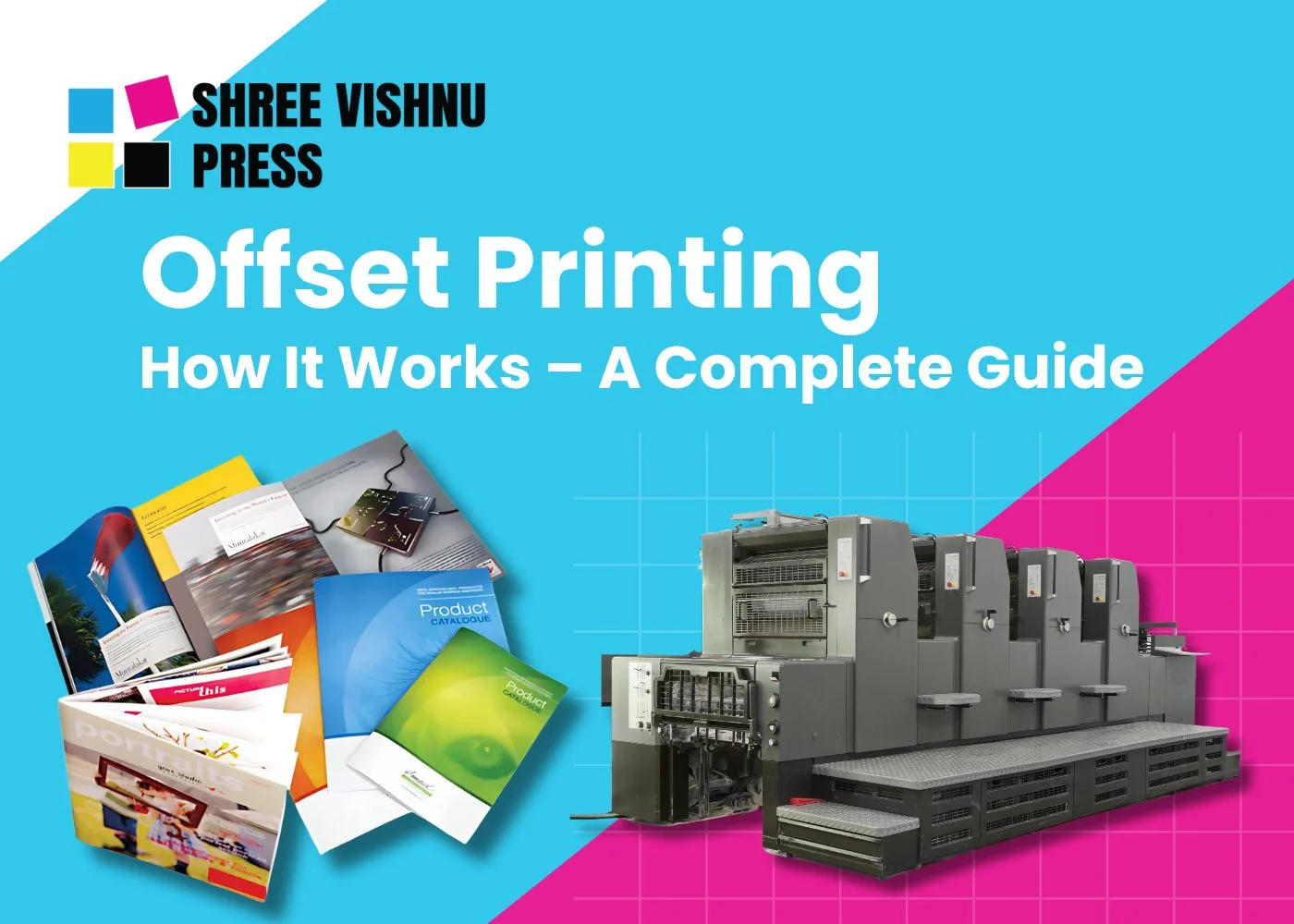
Offset Printing Working is a topic that matters to anyone who orders brochures, books, catalogues or packaging in bulk. You see the results every day in magazines, product boxes and business stationery, but how does a machine produce such sharp, consistent colour on thousands of sheets? This guide explains how offset printing works in plain and simple language, from the first artwork file to the finished sheet.
You will learn what offset printing is, how the offset printing process moves through each stage, how an offset printing machine works inside and when offset is a better choice than digital. Whether you are a student, designer or business owner, understanding the process helps you prepare better files, choose the right paper and ask the right questions.
In-House Shree Vishnu Press Printing Facility
Our Printing Process
A simple 4-step process from your first enquiry to final delivery.
-
1Step 1
Share Requirement
Tell us your product, size, quantity and paper. We send a clear quote and delivery time.
-
2Step 2
Design & Proof
We check your design and share a proof. Printing starts only after your approval.
-
3Step 3
Printing & Finishing
Your job is printed with colour checks, then cut, laminated, folded or bound as needed.
-
4Step 4
Quality Check & Delivery
Final inspection, safe packing and on-time delivery to your doorstep.
What Is Offset Printing?
What is offset printing? It is a commercial printing method in which an inked image is transferred, or offset, from a metal plate to a rubber blanket and then onto paper or another material. The image never goes straight from the plate to the paper. The blanket sits in between, and that extra step gives the method its name and much of its quality.
Offset printing is also called offset lithography. Lithography rests on a simple natural fact: oil and water do not mix. The method developed in the early twentieth century from older stone lithography and became the dominant way of printing books, magazines, newspapers, catalogues and packaging. Even with the growth of digital printing, offset remains the standard for medium and large runs because it gives accurate colour, fine detail and a cost per copy that falls as quantity rises.
How Does Offset Printing Work? The Principle Behind It
To understand how does offset printing work, start with the plate. A printing plate, usually made of aluminium, is prepared so that the image area attracts oil-based ink while the non-image area attracts water. When the plate is dampened with a thin film of water and then touched by ink rollers, the wet areas reject the ink and the image areas accept it. The plate now carries an inked image, and only the image.
This inked image is pressed onto a soft rubber blanket, which picks it up in reverse. The blanket then presses against the paper and passes the image on in the correct reading direction. Because the blanket is soft and flexible, it fits closely to the texture of the paper, which helps ink lay down evenly on many different surfaces. It also protects the hard metal plate from constant contact with paper, so plates last through long print runs.
Colour is built by layering. Most jobs use four process inks: cyan, magenta, yellow and black, known as CMYK. Each ink needs its own plate, and the paper passes through each colour in turn. A specific brand shade, known as a spot colour, uses an additional plate and ink.
Offset Printing Machine Working: The Main Parts Explained
An offset press may look complicated, but every part has a clear job. Understanding offset printing machine working helps you see why setup takes time and why consistency is so high. A typical sheet-fed press has the following parts.
- Picks up sheets from a stack, usually with suction, and places them against guides so every sheet enters the press in exactly the same position.
- Plate cylinder. Holds the metal plate. Each colour unit has its own plate cylinder carrying the image for that colour.
- Dampening system. Applies a thin, even film of water mixed with additives, called fountain solution, so that non-image areas stay clean.
- Inking system. A train of rollers that spreads ink into a very thin, even layer and delivers it to the plate.
- Blanket cylinder. Carries the rubber blanket that receives the inked image from the plate and transfers it to the paper.
- Impression cylinder. Presses the sheet firmly against the blanket so the image transfers cleanly and completely.
- Carries printed sheets out of the press and stacks them, with a spray or dryer to help prevent marking.
A four-colour press has four of these printing units in a row, so a sheet can receive cyan, magenta, yellow and black in a single pass. Some presses add units for a spot colour or a coating, and some can print both sides of a sheet in one run.
The Offset Printing Process Step by Step
The Offset Printing Process is more than the moment ink touches paper. Quality is decided at every stage, from file checking to finishing.
Step 1: Artwork and Prepress
The process begins with the design file. Prepress staff check colour mode, image resolution, fonts, bleed and trim marks. The artwork is separated into its CMYK components and any spot colours are identified. A proof is then produced so the customer can approve layout and colour before anything is printed. Mistakes found here cost far less than mistakes found after printing.
Step 2: Plate Making
Once the proof is approved, the image for each colour is written onto a plate. Modern workshops use computer-to-plate technology, in which a laser exposes the plate directly from the digital file. The plate is then processed so that the image area accepts ink and the rest does not. A four-colour job needs four plates, one for each ink.
Step 3: Press Setup and Make-Ready
Operators mount the plates, load the paper and set ink and water levels. They run test sheets and adjust until the colour matches the approved proof and every colour lines up exactly with the others, a step called registration. This stage is called make-ready, and it explains why offset has a setup cost that is spread across all copies.
Step 4: Printing
When the settings are correct, the press runs at full speed. Water and ink reach the plate, the inked image moves to the blanket, and the blanket transfers it to each sheet as it passes between the blanket and impression cylinders. Operators inspect sheets continuously and adjust ink density so the first copy and the last copy look the same.
Step 5: Drying
Offset ink must dry or cure before a sheet can be handled. Conventional inks dry as they soak into the paper and react with air, which takes time. Some jobs use UV inks that harden instantly under ultraviolet light. Proper drying prevents smudging and set-off, which is ink marking the back of the next sheet.
Step 6: Finishing and Quality Check
After drying, sheets are cut, folded, laminated, coated, die-cut or bound depending on the product. A brochure may only need cutting and folding, while a book needs folding, gathering and binding. A final careful quality check confirms colour, cutting accuracy and count before the order is packed.
Types of Offset Printing
Not all offset presses are the same. They are most often classified by how paper is fed and by how the plate is kept clean.
Sheet-Fed and Web Offset
Sheet-fed presses print on individual sheets and are used for brochures, books, catalogues, stationery and packaging. They allow a wide choice of paper and board. Web presses print on large continuous rolls at very high speed and are used for newspapers, magazines and very large runs.
Wet and Waterless Offset
Conventional, or wet, offset uses the water and ink balance described above. Waterless offset uses special plates with a silicone layer that repels ink in non-image areas, so no dampening water is needed. Wet offset is far more common, while waterless is chosen for particular quality and consistency goals.
Offset Printing vs Digital Printing
| Feature | Offset Printing Services | Digital Printing |
|---|---|---|
|
Best For |
Bulk printing |
Short runs |
|
Color Quality |
Extremely high |
Medium to high |
|
Cost |
Low per piece in bulk |
High per piece |
|
Speed |
Fast for bulk |
Fast for small jobs |
|
Material Options |
Very wide |
Limited |
|
Customization |
Limited |
Highly flexible |
Advantages and Limitations of Offset Printing
Offset printing remains popular because of clear strengths, but it is not the right answer for every job. The main advantages are listed below.
- Consistent colour from the first sheet to the last, even over very large runs.
- A lower cost per copy as quantity increases, because setup cost is shared.
- Sharp text and smooth photographs, with excellent detail.
- A wide range of papers, boards and finishes, including coatings and special inks.
- Support for spot colours, so brand shades can be matched closely.
The limitations are equally important. Setup takes time and money, so very small quantities are usually cheaper with digital printing. Changes after plates are made mean new plates, which is why careful proof approval matters. Offset also cannot print a different name or number on every copy. Knowing these limits helps you choose the method that fits your job.
Offset Printing at Shree Vishnu Press
Shree Vishnu Press applies this process to commercial work such as business stationery, brochures, catalogues, books, magazines and packaging. Our offset printing services are supported by digital printing, large format printing, custom packaging, metalized printing, finishing and design services, so a project can move from artwork to finished product with one team.
We believe an informed customer gets a better result. That is why we explain choices such as paper, finish and quantity before printing starts, and why a proof is shared for approval before plates are made. If you want to know more about local capabilities, read our guide to offset printing in Okhla.
Tips to Get the Best Result from Offset Printing
Good results begin before the press starts. These simple habits reduce delays and protect quality.
- Design in CMYK mode, because RGB colours on a screen can look different on paper.
- Use images at 300 DPI at the final printed size.
- Add 3 mm bleed on all sides and keep important text well inside the trim edge.
- Convert fonts to outlines or embed them in the PDF.
- Choose paper for the purpose: lighter stock for inside pages, heavier board for covers and packaging.
- Check the proof carefully, because changes after plate making add cost and time.
- Plan finishing such as lamination or binding early, since it affects paper choice and delivery time.
In-House Printing Facility


About the Author
Shree Vishnu Press is a trusted printing company in Delhi, known for quality work, honest pricing and on-time delivery. Our team handles everything from stationery to books, catalogues and packaging, and shares practical printing advice based on real, hands-on experience with publishers, schools and businesses.
Conclusion
Offset printing works by combining a simple natural principle, that oil and water repel each other, with precise machinery. A plate carries the image, a rubber blanket transfers it, and an impression cylinder presses it cleanly onto paper, one colour at a time. Careful prepress, plate making, make-ready, drying and finishing then turn that principle into consistent, professional results.
Now that you know offset printing working from file to finished sheet, you can judge quotes, prepare files and choose materials with confidence. Shree Vishnu Press is ready to bring that process to your next catalogue, book, brochure or packaging project.

FAQs
Offset printing is a commercial printing method in which ink is transferred from a metal plate to a rubber blanket and then onto paper. Because the image is offset through the blanket, the print is sharp and consistent, which is why it is widely used for books, brochures, catalogues and packaging.
Offset printing working starts with plates: each colour in your design gets its own plate. The plate is dampened with water and touched by ink rollers, so ink sticks only to the image area. The image moves to a rubber blanket and then onto the paper. Four plates in CMYK combine to form a full-colour print.
The main parts are the feeder, plate cylinder, dampening system, inking system, blanket cylinder, impression cylinder and delivery. Understanding offset printing machine working means knowing that each colour unit repeats the plate, blanket and impression sequence for its own ink.
The offset printing process runs through six stages: artwork and prepress, plate making, press setup and make-ready, printing, drying, and finishing with a quality check. Proof approval before plate making helps avoid costly changes later.
It is called offset printing because the inked image is not printed directly from the plate onto the paper. It is first offset, or transferred, to a rubber blanket, and the blanket then prints the image onto the paper.
Offset printing uses oil-based ink and water because they repel each other. The plate is prepared so that image areas accept ink and non-image areas hold water. This keeps ink only where it is needed and gives clean, sharp edges.
Offset printing uses plates and a blanket, needs setup and becomes cheaper per copy as quantity grows. Digital printing prints straight from a digital file with minimal setup, so it suits small and personalised runs. Choose based on quantity, colour needs and timeline.
CMYK stands for cyan, magenta, yellow and black, the four process inks that combine to create a full range of colours. Each ink needs its own plate, so a standard full-colour job uses four plates. Spot colours need extra plates.
Sheet-fed offset prints on individual sheets and suits brochures, books, stationery and packaging with a wide choice of paper. Web offset prints on continuous rolls at very high speed and suits newspapers, magazines and very large runs.
Choose offset printing when you need larger quantities, accurate brand colours, a wide choice of papers or special finishes. For very small quantities or personalised copies, digital printing is usually the better fit. A printer can advise you after reviewing your quantity and specifications.
Offset Printing: How It Works – A Complete Guide, How Offset Printing Machine Works, How Does Offset Printing Work, How Offset Printing Works, How Offset Printing Press Works
Offset Printing: How It Works – A Complete Guide, How Offset Printing Machine Works, How Does Offset Printing Work, How Offset Printing Works, How Offset Printing Press Works
What Our Customers Say
Discover how Shree Vishnu Press supports businesses, schools and publishers with professional printing, packaging and publishing solutions.
Write a Google ReviewOffset Printing Working, offset printing machine working, Offset Printing Process, How Does Offset Printing Work, What is offset printing
Offset Printing Working, offset printing machine working, Offset Printing Process, How Does Offset Printing Work, What is offset printing
Offset Printing Working, offset printing machine working, Offset Printing Process, How Does Offset Printing Work, What is offset printing