

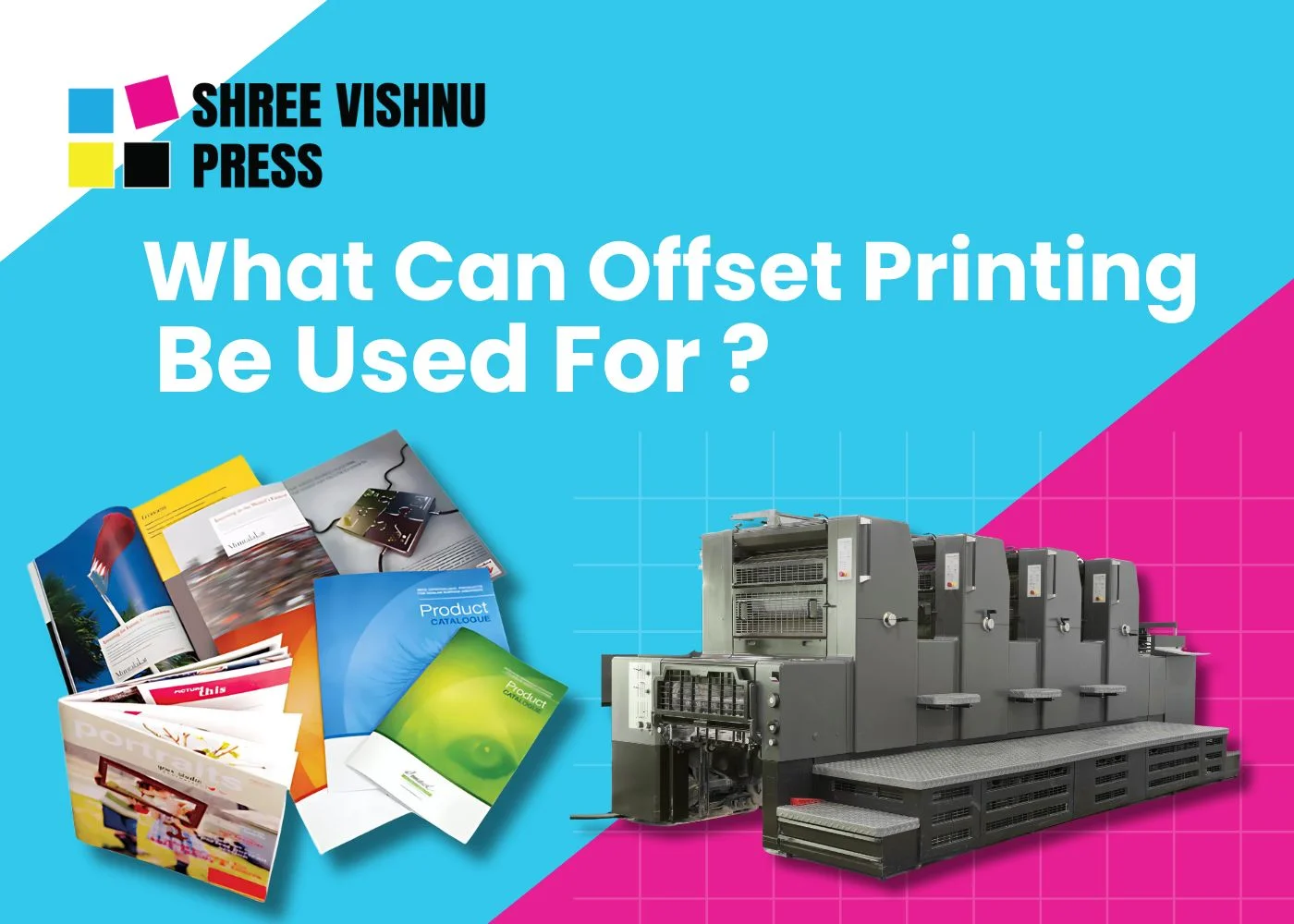
What Can Offset Printing Be Used For ?
Get Latest Quote
overview
What Can Offset Printing Be Used For? Uses, Materials, Advantages and Limitations
What can offset printing be used for? In short, offset printing is used for books, magazines, brochures, catalogues, packaging, labels, stationery, calendars, forms and many other products that need accurate colour, sharp detail and a low cost per copy on medium and large quantities. It prints on a wide range of papers and boards, and in specialised forms even on plastics and metal.
This guide explains offset printing uses in detail, from everyday business stationery to carton packaging. You will see which materials work best, what offset printing can be used for on paper, the main advantages and disadvantages of offset printing, and when another method is the smarter choice. If you are planning a print order, it will help you match your project to the right process.
In-House Shree Vishnu Press Printing Facility
Our Printing Process
A simple 4-step process from your first enquiry to final delivery.
-
1Step 1
Share Requirement
Tell us your product, size, quantity and paper. We send a clear quote and delivery time.
-
2Step 2
Design & Proof
We check your design and share a proof. Printing starts only after your approval.
-
3Step 3
Printing & Finishing
Your job is printed with colour checks, then cut, laminated, folded or bound as needed.
-
4Step 4
Quality Check & Delivery
Final inspection, safe packing and on-time delivery to your doorstep.
How Offset Printing Works in Brief
To understand why offset suits so many jobs, it helps to know how offset printing works. Your design is separated into cyan, magenta, yellow and black, and a metal plate is made for each colour. The plate is dampened with water and touched by ink rollers, so oil-based ink sticks only to the image area. The inked image is transferred to a rubber blanket, which then presses it onto the paper.
Because the blanket is soft, it fits the surface of the paper closely, giving smooth, even colour. Because the plate never touches the paper directly, it lasts through long runs. Once the press is set up, each extra copy costs very little. That combination of quality and economy explains why offset is used across so many industries.
Offset Printing Uses: The Main Applications
The most common offset printing uses fall into a few clear groups. Each group depends on the same strengths: consistent colour, fine detail and economical quantities.
Books, Magazines and Publications
Offset is the standard method for school and trade books, textbooks, manuals, journals, magazines and annual reports. Text stays crisp even at small sizes, photographs reproduce smoothly, and every copy in a long run looks the same. Binding methods such as saddle stitching and perfect binding combine easily with offset printing.
Marketing and Promotional Material
Brochures, flyers, leaflets, posters, product catalogues, presentation folders, direct-mail pieces and company profiles are classic offset jobs. Brand colours stay accurate across thousands of copies, and finishes such as lamination or spot coating give a premium feel that supports brand image.
Packaging and Labels
Folding cartons, product boxes, bags, hang tags, inserts and paper-based labels are among the largest offset printing uses. Offset handles fine detail, exact brand colours and special finishes such as metallic effects, coatings and embossing. Because a single design can be printed on many thousands of cartons consistently, brands rely on it for retail packaging.
Business Stationery and Forms
Letterheads, envelopes, visiting cards, notepads, bill books, invoice books and multi-part forms are printed by offset in bulk. Carbonless papers designed for business forms work well in offset, so duplicate and triplicate books are common offset products.
Newspapers and High-Volume Periodicals
Newspapers and large-circulation magazines use web offset presses, which print on continuous rolls of paper at very high speed. This is a different type of machine from the sheet-fed presses used for brochures and packaging, but it uses the same offset principle.
Calendars, Invitations and Greeting Cards
Wall calendars, desk calendars, diaries, wedding cards, event invitations and greeting cards are often printed by offset because they need rich colour, quality paper and special finishes. Note that offset prints the same design on every copy. Cards with a different name or number on each copy are better produced digitally.
Specialty Jobs: Plastics, Metal and Security Print
With suitable inks and processes, offset can print on certain plastics, synthetic papers and metal sheet. A variation called dry offset is used for non-porous items such as plastic containers. Security papers, gift cards and similar specialised products also use offset technology, though these jobs need dedicated equipment and expertise.
Offset Printing Uses by Industry
Looking at offset printing uses by industry shows how widely it is relied on. Publishers and educational institutions use it for textbooks, workbooks, question papers and prospectuses. Retail and consumer brands use it for cartons, labels, shelf material and catalogues. Pharmaceutical and food companies use it for outer cartons and inserts that must stay consistent from batch to batch.
Corporate offices use it for annual reports, company profiles, stationery and presentation folders. Real estate, hospitality, healthcare and travel businesses use it for brochures and menus that must look premium. In every case the reason is the same: dependable colour and a sensible cost when the quantity is large.
Sheet-Fed and Web Offset: Which Jobs Use Which?
Two press types cover most offset printing uses. Sheet-fed presses print on individual sheets and handle the widest variety of papers and boards. They are the usual choice for brochures, books, stationery and packaging. Web presses print on large continuous rolls at very high speed and become more economical for very large quantities, which is why they are used for newspapers, magazines and big catalogue runs.
For most businesses ordering brochures, cartons or books, the job runs on a sheet-fed press. Web offset only makes sense when the quantity is large enough to justify its setup. A good printer will tell you which route fits your requirement.
What Can Offset Printing Be Used For on Paper?
Paper is where offset performs best. If you are asking what can offset printing be used for on paper, the answer is almost every common stock. The right choice depends on the product and the impression you want to create.
- Uncoated and maplitho paper: suited to books, notebooks, forms and stationery where easy reading and writing matter.
- Gloss and matt art paper: used for brochures, catalogues and magazines that need vivid or elegant images.
- Art card and duplex board: used for covers, folders, cartons and hang tags that need stiffness.
- Textured and specialty paper: used for invitations, premium stationery and luxury brochures.
- Recycled and certified paper: used where sustainability matters, with good print results when the stock is chosen well.
- Carbonless and synthetic paper: used for multi-part forms and tear-resistant or water-resistant products.
Paper weight, measured in GSM, also matters. Light stocks suit inside pages, while heavy stocks suit covers and packaging. A good printer will suggest the right combination of paper, finish and binding for your budget.
| Product | Why offset suits it | Typical material |
|---|---|---|
|
Books and textbooks |
Sharp text and consistent colour over long runs |
Maplitho or art paper, card cover |
|
Brochures and catalogues |
Accurate brand colour and fine image detail |
Gloss or matt art paper |
|
Folding cartons and boxes |
Fine detail, special finishes and low cost per carton |
Duplex or art board |
|
Letterheads and stationery |
Clean print and economical bulk quantities |
Uncoated or textured paper |
|
Forms and bill books |
Efficient multi-part printing in bulk |
Carbonless paper |
|
Calendars and invitations |
Rich colour and premium finishes |
Art card or specialty paper |
Finishing Options That Extend Offset Printing Uses
Finishing is a big reason offset is chosen for premium work. After printing, sheets can be laminated for protection, coated for gloss or a soft touch, embossed for texture, foil stamped for a metallic accent, die-cut into shapes, folded, creased and bound. These steps turn a printed sheet into a finished brochure, book cover, carton or invitation.
Because finishing affects both appearance and cost, it is best planned together with paper and quantity. A heavier stock with lamination feels very different from a light stock with no finish, even when the printed design is identical.
Advantages and Disadvantages of Offset Printing
Every process has strengths and limits. Knowing the advantages and disadvantages of offset printing helps you choose well and avoid surprises. Start with the benefits.
- Consistent, accurate colour from the first copy to the last, including spot colours for brand shades.
- A cost per copy that falls as quantity rises, because setup cost is shared across all copies.
- Sharp text and smooth, detailed photographs.
- A very wide choice of papers, boards and special finishes.
- Long plate life and fast running speeds, which suit large orders.
- Excellent suitability for packaging, books and catalogues, where quality matters.
Now consider the disadvantages of offset printing, which are just as real.
- Plates and press setup add cost and time, so very small quantities are usually cheaper with digital printing.
- Changes after plate making mean new plates, so careful proofing is essential.
- Each copy is identical, so personalised printing with different names or numbers is not practical.
- Turnaround for a single small job can be longer than digital because of setup and drying.
- Colour balance takes skill, so quality depends on an experienced operator.
In-House Printing Facility


Offset Printing at Shree Vishnu Press
Shree Vishnu Press uses offset printing for brochures, catalogues, books, magazines, stationery, forms, calendars and packaging. Alongside it we offer digital printing, large format printing, custom packaging, metalized printing, finishing and design services, so your project can move from artwork to finished product with one team.
Because we offer more than one method, we can recommend the one that suits your quantity, paper and budget rather than pushing a single process. We explain choices clearly and share a proof for approval before plates are made, so you know exactly what you will receive.


About the Author
Shree Vishnu Press is a trusted printing company in Delhi, known for quality work, honest pricing and on-time delivery. Our team handles everything from stationery to books, catalogues and packaging, and shares practical printing advice based on real, hands-on experience with publishers, schools and businesses.
Conclusion
So, what can offset printing be used for? Almost every kind of professional printed product that needs consistent colour and economy in volume: books, magazines, brochures, catalogues, packaging, labels, stationery, forms and calendars. It performs especially well on paper and board, and with the right setup it can reach plastics and metal as well.
Knowing the advantages and disadvantages of offset printing lets you use it where it shines and choose another method where it does not. With clear specifications, an approved proof and the right paper, offset printing delivers reliable, professional results for businesses of every size.
Faqs
Offset printing can be used to print a wide range of materials, including brochures, flyers, business cards, packaging, books, magazines, calendars, labels, and more.
Offset printing is more cost-effective for large print runs. For smaller quantities, digital printing may be a more affordable option.
Yes, offset printing allows for various custom finishes, such as embossing, foil stamping, and spot UV coating, which can enhance the appearance of printed materials.
The time required for offset printing depends on the complexity of the project and the print volume. It typically takes longer than digital printing due to the setup process.
Industries that require high-quality, large-volume printing benefit the most from offset printing, including publishing, advertising, packaging, and corporate branding.
What Can Offset Printing Be Used For ?, Digital Vs Offset Printing Press, Offset Vs Digital Printing Cost, Digital Vs Offset Printing
What Can Offset Printing Be Used For ?, Digital Vs Offset Printing Press, Offset Vs Digital Printing Cost, Digital Vs Offset Printing
What Our Customers Say
Discover how Shree Vishnu Press supports businesses, schools and publishers with professional printing, packaging and publishing solutions.
Write a Google Reviewoffset printing uses, What can offset printing be used for on paper, Advantages and disadvantages of offset printing, How Offset Printing Works, What Can Offset Printing Be Used For ?
offset printing uses, What can offset printing be used for on paper, Advantages and disadvantages of offset printing, How Offset Printing Works, What Can Offset Printing Be Used For ?
offset printing uses, What can offset printing be used for on paper, Advantages and disadvantages of offset printing, How Offset Printing Works, What Can Offset Printing Be Used For ?